Sunday, June 16, 2013

Squeezing the Tube of Communication

I love my kids, but they drive me crazy sometimes. When they were little, I could always bank on the fact that their sink would be messy with toothpaste. When they squeezed the tube, toothpaste would invariably go everywhere. Why couldn't they just squeeze the toothpaste like I did?  After all, it's ridiculously easy.  Oh wait.  I used to get it all over the place, too.

The interesting thing about toothpaste is that once it comes out of the tube, there's no way to put it back inside. No matter how much you try, it won't go back in, and there's nothing you can do about it. And if you think deeper about this subject, our words are just like toothpaste. Once they come out, there's no going back. 

The reason toothpaste gets all over the place is because we don't take enough time to carefully squeeze the tube. Our words are the same. When we don't use caution or think through what we want to say, our words will get messy and offend others. 

So how can we clean up the messes that our mouths make?

Think through Emotions
Have you ever tried to put toothpaste on your toothbrush when you're in a ridiculous hurry. Chances are you're going to miss your toothbrush. Choosing words in the heat of the moment is no different. You must make sure that you calmly think through your emotions before choosing the words that you're going to say. Think before you speak.  

Use your Words Wisely
Toothpaste was designed to keep our teeth cleaned, not get our clothes dirty. By selecting words that help us focus on the problem and improve our situation, we use our words wisely. We build others up. We build trust. We build stronger lines of communication.  We keep our relationships in good standing. 

Brevity is Golden
Nothing is more annoying than someone that talks on and on and on. Brevity is the equivalent of putting just the right amount of toothpaste on the toothbrush. Too little and the job won't get done. Too many words, and everyone gets annoyed with you. Too many words is like having too much toothpaste. Get to the point!

Ensure Accuracy
Never in the history of the world have we had so many words to use.  The problem is that with so many words, there are so many different interpretations of what each word means. Take time to make sure that your words accurately describe what you are thinking and feeling. By making this effort, it is certain that communication will clear up any ambiguity.

Success
My kids finally learned to squeeze the tube correctly. Their dexterity improved. Their patience grew, and most importantly, they remembered to clean up after themselves. They matured from their repeated practice. 

To become successful with the tube of communication, we, too, must get messy before we can learn to communicate clearly. Making mistakes improves our verbally dexterity, and cleaning up our own messes prepares us to be more effective communicators in the future. Communication is never easy, and it never will be, but with repeated practice, it can become a little easier every day. 


Monday, June 10, 2013

The 5 Fingers of Leadership

The most unproductive leadership action is pointing the finger at someone. We've all done it at some point in our lives. We've said, "He did it. It wasn't me!"  And let's face it, it absolves us from responsibility and makes us feel better to know its not our fault.


But let's get real. If all we had was 1 finger, our lives would be pretty difficult.  We wouldn't have the dexterity to get things done.  

So here's my question, how many fingers do you have in your leadership?  The picture above shows the analogy how leaders should use all 5 fingers to empower excellence and use them not to point at the right person, but to the right problem. 

Pinkie 
The least threatening finger of all is the greatest digit. It is the pinkie of positive presuppositions and trust (have you ever pinkie sweared?). Leaders must assume that people give their best even when they fail. Leaders must also assess the trust factor in the situation before moving to other fingers. 

Ring Finger
This finger of commitment is often lacking especially in leaders that constantly find fault in people. A true leader displays true commitment is times of adversity. Before resorting to pointing the finger, real leaders turn to their commitment to help people first and then to finding the fix second. Commitment is about supporting people in solving their problems.

Middle Finger
The middle finger is responsible for 35% of the entire hand's grip strength; thus it is the finger of teamwork. Leaders must analyze if there is a support issue when problems arise. Without teamwork, problems persist. Before finding fault, search for support and build capacity in teams to repair mistakes. 

Thumb
The strongest and most unique digit of all is the thumb. The thumb doesn't point at the accused or the accuser. It points upward to a place I'd like to call opportunity. The greatest leaders look at every obstacle as an opportunity.  Leaders search for a bigger issue that could be the root of the problem?  The thumb will always point you in that direction. 

Index Finger
The most destructive and productive finger of all is the index finger. It can offend, but it can also affirm. Real leaders  use this finger to confront only after they have exhausted all other options.  Powerful leaders use the index finger to build people up. They point to others and say, "You Rock!"  They point out expertise, celebrate strength and encourage others. 

Don't Forget...
When you point the finger at someone, you have 3 pointing back at you. So if you're going to point the finger, you better make sure you have assumed the best, demonstrated commitment and built teams of support first. Next, look to your thumb to ensure you've identified the right problem.  Finally, if you employ all 5 fingers of leadership, you'll always be pointing not at the right person, but at the right problem. 


4 Gifts that ALL Kids Deserve from their Dad

It's Father's Day Weekend, and I want to take this opportunity to remind you and me what Father's Day is all about. We often get so covered up trying to provide for the family that we often forget what our kids need from us the most. They won't remember how high we climbed on the career ladder. They won't value our accolades and accomplishments like we do. In fact they really don't care that we work, but there are 4 gifts that every child deserves to receive from their dad.

4 GIFTS FROM DAD 

Time
This is the number one thing all kids need from dad. Kids value quality time spent with their dad. No matter what happens, kids want to spend as much time as possible with their dad. The way we spend our time builds or tears down their self confidence and ultimately tells them just how important they are. 

Spend lots of time with your kids!


Education
Dads play a huge role in education. We place the value on education. If kids see that their dad is involved in their education, they will place a high priority on it as well.   The key word is involved, not aware. Dads need to be actively involved (doing something) in order for their kids to see its benefit. If dads aren't involved in helping their kids learn, the kids won't be involved in learning or see its value either. 

Teach your kids to love learning.


Spirituality
All children are born into this world with an innocent spirit. It is the dad's job to protect and nurture their children's spirits. That means dads must develop their own spirit first and then show their children how to discover and build their faith. 

Pray for and with your kids.


Love
Faith, hope and love are the greatest gifts, but the greatest of all is love. Real dads drop the bravado and show their children love through both word and action. Children who hear and see their daddy's love will have the greatest gift that no tangible item could ever replace.

Hug your kids, and tell them you love them. 


The older I get, 
The more I reflect on whether or not my kids are getting enough of their real needs met by me. One day they will be on their own, and they will not need their dad.  I hope I will have done the best I could to teach them the value of time well spent, the importance of a great education, the positive impact of spirituality, and what love truly is.  If I did my job, there's a strong chance that I will have succeeded as a dad in preparing them for the crazy world that awaits them. And if I'm really lucky, they won't need their dad. They'll want him. 

Thursday, June 6, 2013

The 6 C's of Collaboration

Every team desires collaboration. Every leader preaches collaboration. But the question remains, is collaboration more of a new buzzword in our work or truly an actual practice.

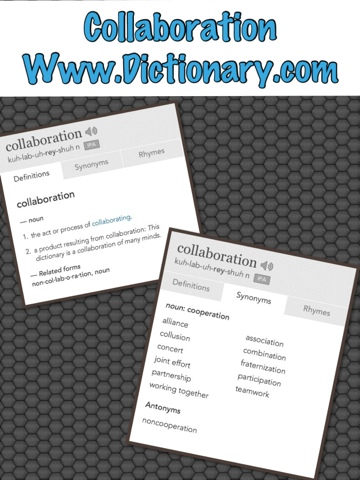
Below are the definitions of and synonyms for collaboration. What I found particularly interesting was the 2nd definition of collaboration. Collaboration is a product as the result of collaboration. To me that would be the pinnacle of collaboration. Obviously, there is a lot that must take place before a collaborative team can develop a collaborative product. 


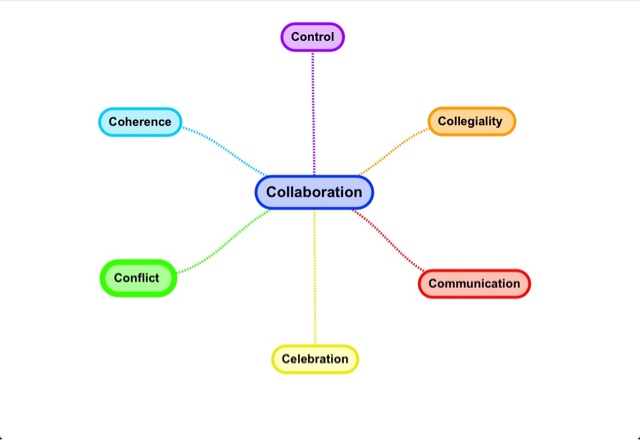
What are the 6 Cs or the 6 Conditions necessary for a collaborative team to move to this level of interdependence?

Conversation
Teams must be able to talk openly and honestly about the work that they must do to help kids. Without frequent and focused conversation, teams can't even begin their journey toward collaboration. Members must realize that conversation requires communication that is empathic in nature and supportive in posture. No conversation can exist without intentional listening, so teams rich in conversation don't just hear. They synthesize what each member is saying to ensure that collaboration can reach the deepest levels possible. 

Coherence
As a result of frequent conversation and their ability to develop trust in one another, coherence in the team's work will emerge. The more clarity that exists in each team member's role, responsibilities, and expectations for contribution, the more coherent the team's thinking, planning and understanding will become. In other words, coherence is best described as logical and consistent interconnection between all members of the team and the daily work that they do. 

Collegiality
As trust and understanding emerge, collegiality becomes a norm of the collaborative process.  Collegiality can best be defined as the cooperative interaction among professionals. Before collegiality can begin to exist, team members must first view one another as professionals and second, depend on each member to possess and contribute specific levels of expertise necessary to make the team better. Without collegiality, collaboration is dead in the water. 

Conflict 
A necessary component of any growth process is conflict. To move from one place to another, friction must occur. Collaborative teams that move quickest realize that in order to minimize negative friction, members must respect one another's values, beliefs and experiences and not allow professional conflict to derail the creative process by becoming personal. Professional conflict is a requirement of the collaborative process, and through open and honest conversation and collegiality, professional disagreements are viewed as a vital component of the collaborative process. 

Control
When one person controls the collaborative process, collaboration becomes null and void. Control on a collaborative team is shared by all. Norms for working together are developed collectively and enforcement of such norms is also viewed as the responsibility of all. Ultimately the buck has to stop with someone, the leader; however, when all team members are committed to the collaborative mission of the team, leaders rarely need to step in to take control. In essence, each member's commitment to the team's purpose and products demonstrates the team's level of shared control. 

Celebration 
Teams that celebrate together accelerate together. Teams that collaborate at the highest levels understand that they must celebrate every achievement, both big and small. But teams also understand that they must celebrate when they fail. Failure is a result of learning and experimentation. When someone fails, the team has the opportunity and obligation to learn from it. When teams engage in high caliber celebration, risk-taking flourishes and the fear factor dissipates. Finally, job satisfaction and commitment to the mission and vision of the campus accelerates when teams celebrate. 


So what do you think of the 6 C's of Collaboration?  Do you agree or disagree or better yet, do you have additional suggestions to add to the Conditions of Collaborative teams?


Monday, June 3, 2013

Build Interdependence in your Leadership Team

In my post on Layers of Leadership, I clarified that leadership teams have layers that go from specific areas of leadership (teacher leaders) to broad areas of leadership (campus leaders). By themselves their leadership potential is not potent, but when the layers work interdependently, their potential grows exponentially. Interdependence occurs when there is a high level of trust, respect and dependence on another.  Leaders on a team with a high level of trust are selfless in their commitment to the cause and will do anything to help their fellow teammates.

Here are some tips that leaders can employ to foster higher levels of trust, teamwork and interdependence.

1. Establish Norms - Just like teams need norms for working together, leaders that work together need to create norms on everything from when to meet to how to resolve conflict. If leaders fail to norm their behaviors in working together, they will not be prepared to get through difficult or stressful situations. In addition, they will undermine their own leadership with the people that they work with.  Successful relationships depend on making agreements of how we will work together.

2.  Respect the Expertise of One Another - Everyone is trying their best to do their part to lead their area.  It is critical that leaders respect one another's ability and effort to lead and not rush to judgement when problems arise.  If leaders rush to judgement, they may cause damage to the team's trust. In summary, model professional courtesy.

3. Celebrate One Another's Successes - Everyone has an easy time finding problems, but leaders must help one another find the small victories along the way and celebrate them together. Leaders that work together are always helping one another celebrate what's going right and motivating one another to stay the course.

4. Learn from Mistakes - Mistakes are a regular part of learning. Interdependent leaders support each other as they identify mistakes and use them as learning tools for improvement rather than a catalyst for placing blame. Managers view mistakes as a problem; leaders see mistakes as the point where improvement can begin.

5. Have Fun - Leading is hard work, but it can be the most rewarding work if you lead with a joyful heart. Leading with a joyful heart demonstrates that you appreciate the opportunity and the challenge that you have been given. Having fun is contagious and motivates everyone around you.  Fun increases productivity and creativity.  Most important adding fun to the mix during difficult times makes the work a lot more enjoyable for all.

When all members of a leadership team employ the strategies listed above, teams excel. They excel because the leaders model how the organization must stay focused on the mission and vision. They stay focused by committing to the team's goal and by doing whatever it takes to support one another in achieving the goal. Leaders who work interdependently show the rest of the staff the benefits of working interdependently also.

Monday, May 27, 2013

An Emmy-Winning Norm

The sitcom Cheers was a mainstay on television sets across America in the 1980’s.  In every episode, a regular occurrence took place.  Norm Peterson, a mainstay of the bar, Cheers, would enter the front door.  Upon his regular entrance, Norm would say, “Evening, everybody”.  The bar would yell, “Norm!!!”.  One of the main characters would ask Norm a question and Norm would reply with a hilarious one-liner response.
The recipe was genius.  Every viewer was hooked, and they expected this norm each time they watched the show.  It was simple, yet powerful.  Norm’s entrance was not powerful because it rarely occurred.  It was powerful because his grand entrance occurred every time without fail, with timely precision and with epic comedic appeal.
Teams need the same type of routine.  They need regularity in coming together, collaborating together and committing to one another.  According to Rick DuFour, a team consists of a group of people who work interdependently to achieve a common goal for which they are mutually accountable.  If a group of people wish to be a team, they must be committed to a goal that every member plays an integral part in achieving.  Furthermore, the members of the team must be committed to contribute toward the goal as well as depend on one another to improve personally.  Teammates must have guidelines to work together, support one another, and confront behaviors that prevent progress toward outcomes that they agreed to work toward.
In order for a group to become a team, teams must collectively create guidelines as known as norms.  With each member contributing their ideas of how to work together, norms should define how the team will come together, have a purpose for meeting and leave with a useful product for each member to implement in their classroom.
When teams are creating norms, they should ensure that the following criteria are addressed:

Time

  • What are the agreed upon times that the team will start and end the meeting?
  • How will the team make certain that time is maximized and not wasted?
  • How will members address others who waste team time?

Purpose

  • What is the primary purpose for the team coming together?
  • What issues will the team discuss during the allotted meeting time?
  • How will members prevent off-topic issues from deterring the team away from its purpose?
  • How will members confront others who prevent the team from collaborating about the purpose?

Product

  • What common product will all members walk away with from the meeting?
  • What will members bring with them to the meeting to contribute to the creation of the common product?
  • How will members confront others who fail to contribute to the common product?

Interruptions

  • What are interruptions that cannot be allowed in the collaborative meetings?
  • How will team members prevent or stop unexpected interruptions from disrupting the meeting so the team can stay on-task?
  • How will members confront other members and outside guests who interrupt the meeting?

Conflict

  • How will members of the team address disagreements or differences of opinion while maintaining the positive culture of the team?
  • When conflict arises between members of the team, how will the other members work together to help resolve the conflict?
  • When conflict cannot be resolved, how will the team seek support from campus leaders?

Focus on Kids

  • How will members keep the focus of the collaborative meeting on the needs of all students?
  • When the discussion focuses more on the staff ‘s needs than the needs of the kids, how will the team address this issue?

Celebrate

  • When the team accomplishes a goal, how will they celebrate?
  • When an individual member has a success, how will the team celebrate their individual success?
  • When and how often will the team celebrate regularly?
Teams that plan together stay together, but teams that celebrate together, accelerate together. Just like in the show, Cheers, teams must have all the ingredients for collaboration and serve them on a regular basis.  If your team can commit to the norms that they can create, your team will be destined for an Emmy-winning performance.

Monday, May 20, 2013

Closing the Transition Gap

At the end of every year, students learn the material well enough to go to the next grade or the next course of study.  They demonstrate mastery or at least proficiency for their current teacher and the teacher is confident that the student is prepared to learn the following year.

At the beginning of every year, students walk into a new classroom with a new teacher and are asked to show their knowledge acquired from the previous year. All too often, an equal number of students succeed and fail demonstrating their retention of prior learning.  If this is all that is known about the student, the new teacher is left to wonder what the student actually learned last year.

So a gap exists.  Between the time that a student completes school and begins a new year, many factors exist that cause students to be unable to walk into the classroom in August prepared to learn.  Of course, summer regression plays a big part in why students stumble in the initial days of school.  On top of the loss of retention, the learning that the new teacher expects from students is slightly different from the learning that took place in the student's prior year.  Instructional language varies from teacher to teacher and from grade to grade. If students fails to traverse the gap, they will be behind before the first assignment comes their way.

Schools can create transition sheets to help the new teacher learn about students from their previous teacher.  Grades, reading levels, generic behavior infomation are great indicators about the students' performance from the previous year.  A piece of paper can close the gap, but not completely.  Without a deep understanding from both sides of the gap, misunderstandings still exist.  What one teacher deems proficient, another may rate below average.  Something is still missing.

CONVERSATION & COLLECTIVE UNDERSTANDING


Transition sheets created by administration and handed to all teachers to complete is helpful but may not identify the best information for all teachers.  Teachers from adjacent grades must work together to create transition sheets that have common language and concrete quantifiers of proficiency that both parties can understand.  When teachers decide the proficiency of a given skill, teachers must have a precise definition of what the skill looks like and sounds like at the end of the current year and the beginning of the next year.  Teachers must understand how the skill was taught and learned in the previous year, so the next year teacher can build on prior learning for the beginning of the year.

Transition sheets must not be limited to just grades, skills and numbers to gauge proficiency.  The receiving teacher must know what strategies work best for the student.  Strengths and weaknesses in learning the content should be shared.  Interventions and their frequency can give teachers strong indicators of how much support the new student will need to be successful.  Behaviors that prevent learning are a critical piece of data and positive behavior supports that have worked with the student should be communicated.

Transition is a difficult thing for students.  Each year they have to adjust to us.  Each year we have to adjust to them.  Instead of spending the first 6 weeks of school figuring out what they can and cannot do, we should be more proactive and know as much about the kids before they enter our classroom.  If we can do that, we will definitely move in the right direction toward closing the transition gap.