Showing posts with label Learning. Show all posts

Friday, February 27, 2015

Let it Snow or Let it Go: Evaluate your Instructional Activities

There are two competing thoughts about snow this time of year. The first thought of snow is one of wonder, beauty and anticipation. For people like me who live down in Texas, we see snow once every two or three years, so the mere thought of snow coming down brings fascination and excitement to my children's eyes.  I have to admit that I get pretty fired up about it as well.

Now the other side of the spectrum about snow elicits wonder but for a completely different reason.  My friends from the north who have been under several feet of snow for the better part of the  last two or three months express wonder about the snow.  They just wonder when it will ever go away.


Instructional Activities are like Snow

When a new activity is presented to the class, students will engage if and only if the task is interesting and relevant to them.  The higher the relevance, the more interest the activity will generate.  When used sparingly and more importantly at the appropriate time for meaningful learning, instructional activities can bring a lot of joy and excitement to learning.  When the activity is highly interesting and effective, students will want to know when the activity will return. 

When an instructional activity is overused or worse used as the primary learning tool of the class, students will wonder when the lesson will ever end.  Because the activity returns again and again, day after day, student engagement becomes snowed under by mundane redundancy.  If not addressed quick enough, students could become frost-bitten from the effects of the activity or frozen to learning all together.   If you need an mental model of what I'm talking about, see Ben Stein in "Ferris Bueller's Day Off".


"Let it Go" or "Let it Snow"


To ensure that your student engagement doesn't get snowed under by the overuse of an activity, here are some warning signs that will tell you whether the activity needs to stay or go.
  • Neurons freeze
  • Unhappiness accumulates
  • Motivation plummets
  • Behavioral issues increase
When teachers of excellence notice these warning signs, they make adjustments, and they determine what causes student apathy to the lesson.  If they need to, they find a new activity, because they understand this fact about learning.  Instructional activities are not the learning.  They are a tool for learning.  These teachers figure out how they can utilize a new or different activity to warm up their students to learning because they understand that student engagement changes like the weather.

At the end of the day, all of us can predict when students are becoming numb to any of our instructional activities.  The key is to be observant and responsive.  We have to understand that students have different affinities for learning and various reasons that they choose to connect or disconnect from learning.  After all, it is their learning, and when we focus on making learning fun and relevant to our students every day, they will never let go of their wonder and anticipation for learning.

Saturday, February 21, 2015

5 Strategies to Inspire Commitment to Learning

How big a role does involvement play in the arduous task we call learning?  If you think about it, getting all kids involved in learning can be a challenging task.  With all of the learning styles, attitudes about learning, and perceptions that students have about content, great teachers are like sales associates in their approach to hook all students in learning.

But I'd like you to think of involvement in this way.  When kids or adults don't feel included in any task or worse, they feel like the task is being done to them, the chances that they'll take ownership of the task are slim to none.  To synthesize this idea further, read this Stephen Covey quote.

Source:  "Motivational Quotes"
Compiled by Mac Anderson

Evaluate your Student Commitment

To determine the level of student commitment to learning in your class, answer these questions.
  • What percentage of your students are committed to the learning in your class?  
  • How many kids are engaged in learning before you even begin your lesson?  
  • How many students are independently seeking support for concepts that illusive to them?
  • How many students are interested in learning about your content from other students in the classroom?
It's natural to have students that are not committed or even involved in the learning opportunities that we provide, but how we respond to these students determines whether or not we can convince them to choose commitment. 


5 Strategies to Inspire Student Commitment in Learning

  1. Leadership - When kids have the opportunity to help lead the learning, participation grows,
  2. Examples - When examples of student work are used as teaching tools, students motivation increases.
  3. Advancement - When students see how learning tasks help them grow in their abilities and knowledge, they become more committed.
  4. Real-world - When learning is tied to the real-world topics and issues that students can connect with, involvement grows.  The more relevant the learning, the more committed the learner.
  5. N-It-4-Me - Every lesson must be able to be able to answer this ever-present student question, "What's in it for me right now?"  If you can sell your content to your client, the student, chances are they will not only buy what your teaching but sell it to their peers on your behalf.  That's the ultimate form of student commitment to learning.

Learning can't occur at high levels without commitment.  How we intentionally engage kids in class everyday plays a huge role in determining whether or not kids will choose to get involved and ultimately commit to their learning.  When it comes to learning, remember this.  When kids are cognitively and personally involved in their learning, they will commit to any task that you put in front of them.

Friday, February 20, 2015

Rigor, It's All the Rage...

Rigor is all the rage these days, both literally and figuratively speaking.  Everybody from the President on down believes that students must have more rigorous curriculum, more innovative instruction and challenging assessments to prepare them for the 21st century, for a college ready future, for a solid career pathway, and for whatever else we want kids to accomplish in America in the next decade.  But here's the question.  Can anybody that politicizes rigor tell us exactly what rigor looks like?

Diane Ravitch likens the perception of rigor to rigor mortis (a strict and rigid curriculum), and Barbara Blackburn (author of Rigor is NOT a Four-Letter Word) said, "People don't know what it means".  These two experts are right.  Rigor is one of the most confusing buzzwords today, and it has a different meaning depending on who you ask.  So the question becomes this.  How can administrators and teachers work together to define what rigor must look like to inspire kids to achieve success at the highest levels?

For more thoughts on rigor, click HEREHERE and HERE

Rigor Me This.

The problem that I see with rigor is not that we don't have rigor in our classrooms.  It's that we don't have an aligned understanding of what rigor must be so that students will be inspired to reach our rigorous expectations.  What teachers and leaders need is a common language about rigor, so that when someone says, "We Need More Rigor!", everybody knows what that means for kids.

To help educators work together to have some focused conversations about what rigor must mean, I whipped up this table comparing what it is and what it isn't.  My hope is that all educators within an organization will have meaningful discussions about rigor and create a common understanding, so that together they could make a rigorous school instead of rigorous classrooms.
.
Rigor is NOT
Rigor Is
More work
More appropriately
challenging work
Engagement
Cognitive engagement
Teacher
Q & A
Classroom discussion &
student collaboration
Hard classes
Rich learning environments
Hard work
Cognitive work
Selecting Correct
Responses
Making the best decisions from multiple correct responses
Depth of Work
Depth of Knowledge
Knowledge &
Skills
Creativity &
Analysis
Based on the
verbs in a standard
Based on the
complete standard
Frustrating and
overwhelming
Challenging and
motivating


Thoughts
What would you add?  

12 Ways to Empower Student-Driven Learning

As a teenager, I hated driver's ed. Hated it... There was nothing more frustrating than sitting in that dorky car with the badge of shame on the car door that read "STUDENT DRIVER".  Every day I went to driver's ed with two thoughts. "How many more days until I can stop driving around town with this loser label on me, and how can I get rid of this teacher monitoring my driving?"  The day finally came when I was able to shed my scarlet letter of mobility as well as the driving instructor from my car.  I was finally able to drive all by myself.

So who's driving your students' learning in your classroom?


Kids disconnect from instruction that puts them in the passenger's seat. Quick-paced learners become annoyed when they have to wait for slower students. Slower-paced learners shut down when they aren't moving fast enough to keep up with the class. To truly own learning, students must be in the driver's seat. They need to have tasks and activities that engage them at their level and in their modality.   If you think about it, learning is a personal activity just like driving is. In order for kids to own their learning, the teacher can't be the one always driving them around town.  

Image by wealthydebates.com

Here are 12 Ways to Empower Student-Driven Learning


  1. Empower kids to find more than one way to solve a problem. 
  2. Build in collaboration time among students, so they can share their thinking with one another. 
  3. Create a mindset where wrong answers are great teaching tools, not horrible mistakes. 
  4. Provide activities that don't penalize slow-paced learners for not finishing quickly. 
  5. Have ongoing extension activities where faster-paced students can work on a personalized project tied to their interests. 
  6. Lecture only when it is information that the majority of the class must hear. 
  7. Intentionally integrate student discussion and conversation into instructional activities. 
  8. Encourage students to use technology to learn more about your content in a way that fits their learning style . 
  9. Provide students opportunities to preview new content before you teach it. (Flipped instruction)
  10. Limit the amount of time that students have to sit and wait.  The longer they wait, the more disconnected they will become. 
  11. Select activities that cognitively engage minds, not keep them busy.
  12. Provide activities tied to the student's interests. If they aren't interested, they won't own it. 
Please add your thoughts in the comment section.

Let Kids Take their Learning for a Spin

Driving for the first time was the most liberating experience for almost everyone of us.  Being in control as I sped down the road for the first time was awesome because finally being in the driver's seat was the best feeling in the world.  Learning is no different.  When kids have choice and control in determining their own personal pathway to learning, students will surpass engagement and be empowered to drive their learning.


Sunday, February 15, 2015

Overcoming the Failure Mindset

When you hear the word, failure, what thoughts come to mind?  Is it the end of the world, or the beginning of learning? Do you see doom and gloom or an opportunity for improvement?  Failure is a fact of life, but how we view failure and more importantly how we react to it has huge implications on a student's potential for learning. 

No matter your response to my first question, you haven't always viewed a child's failures as crippling limitations. If you think about it, children fail more in the first 3 years of life than at any point thereafter, and at no point did any of us think our children were failures. In fact, our parental statements communicated hope, encouragement and an eternal belief in our children's ability to grow and mature. 

To prove this point, we've all heard statements such as:  "He isn't walking yet", "She isn't out of diapers yet", or "We haven't broken him of the pacifier yet". No matter how concerned we became, we never uttered statements like, "He'll never walk", She'll always be in diapers!", or "I guess he'll suck on that pacifier forever!!!"  No matter the deficit or delay, we believed that our infant children would grow out of their infantile ways because we believed in the "Power of Yet"

Watch this short video by Carol Dweck and read this infographic from @wayfaringpath and ask yourself this question.   

Do you believe in your students and your own abilities enough 
that you know you can help your students 
grow from their failures and reach their potential?  

As educators, it is critical to remember that all students can learn and grow, and they do it at their own pace and in their own unique way.  We must also remind ourselves not to allow a student's failures of the day to drive our beliefs about his potential.  If we can't convince ourselves that students can overcome their failures, there's no way that we'll be able to help them believe they're anything other than a failure.  After all, someone saw more potential in you, and despite your flaws, that person gave you the support and encouragement to turn your setbacks into strengths.


Embedded image permalink
Source:  @wayfaringpath: Growth vs Fixed Mindset Graphic for Elementary 

Saturday, November 22, 2014

5 Fixes for the First 5 Minutes of Instruction

You don't have a second opportunity to make a good first impression. If you get a bad feeling after meeting someone, it's going to take a lot for that person to change your general feelings about them. In other words you better spend time making the best impression the first time, or you'll have to spend lots of time thereafter convincing them that you've got it going on.

The same thing goes for any lesson.  If the kids don't develop a good impression in the first 5 minutes of the lesson, you're going to experience a lot of problems convincing them to stay with you. Great lessons can die in the first five minutes. It's not because they weren't planned well. It's because they didn't make a good impression on the student in the first few minutes. Have you ever had a lesson that included technology, and the technology wouldn't work?  Minute by minute the student engagement morphed into passive disengagement and eventually into disruptive bedlam, and as a result it took three times the time to reengage the students as it did to lose them in the first place.

#5MinutesMatterALOT

But it doesn't have to be this way.  Look at the first 5 minutes as the foundation for learning.  A house built on a sandy foundation won't last long, but a house built upon a rock will last forever. Having homework turned in and materials ready for instruction is not enough to motivate kids for learning in the first five minutes. So how do great teachers create a great foundation for learning?

5 Fixes for the First 5

Here are 5 strategies to engage kids in learning and make an awesome 5 minute impression.

  1. Pose a problem on the board that is tied to your direct instruction.
  2. Padlet - Students can use their cell phones or tablets to respond to a thought-provoking questions.
  3. QR codes - Post a QR code that connects them to your lesson.
  4. Today's Meet - This is a great way to get kids to post their questions or comments about last night's homework while you tend getting class started.
  5. Google me this - Pose a term or concept for students to research through a Google search. 

The first five minutes of instruction is all about igniting minds. It's about connecting what students know to what you want them to know. If students aren't connected to your content, it is kind of difficult for you to create that interest through a lecture or presentation.   The pathway to rigor starts with cultivating a desire to want to know more. If the first five minutes of instruction do not inspire a student to want to know more, the remainder of the class will not be filled with rigor, but with rigor mortis. 


Saturday, November 8, 2014

Is your Mind Fixed on Growth?

Do you have a growth mindset?   Learning is about growing through failure not success.  To synthesize this question at a deeper level, I challenge each one of you to read Bill Ferriter's blog (CLICK HERE) and watch the video at the end.  I rarely say that something is unbelievably amazing, but this concise post (which was unbelievably amazing) fixed my mind on what is most important.  It is the growth not the result that determines if we are learning.  If we can condition ourselves first to become fixated on the progress we are making in our craft as opposed to obsessing about meeting a specific level of mastery, then I am confident that we will be more successful at conditioning our kids to develop the same growth mindset..


As I pondered the idea of growth mindset, I wondered what questions I should ask myself.  That is when I found this infographic by Marc Chernoff from MarcAndAngel.com.  While these questions focus on reflecting on our work at the end of the week, you can ask these questions every time you encounter a failure or setback.  By reflecting and being cognizant about failure, we can identify which strength can be leveraged the next day or next week to improve our deficit area.

Tuesday, October 21, 2014

Take your Content to Deeper Levels of Knowledge through Reading

"Points of Entry" (CLICK HERE) by Nancy Frey and Douglas Fisher  is a great article for any teacher who wants to make their students better at reading, comprehending and explaining what they have read.  Reading is THE foundational skill for every course, but teaching kids how to read is often relegated to the English teacher.  Kids need more reading instruction than any English teacher can provide, but the solution to this conundrum is not to go out and hire more English teachers.  The answer can be found by providing more reading instruction throughout the day.

If we really want students to be better at our content, then we must ensure that we are making them better readers.  In other words, all teachers must consider how reading is being taught explicitly to their students.  Furthermore, reading instruction is thought of as a silent and individual learning activity, but here's the problem with that philosophy.  How many of us read informational texts in our work and never do anything with it?  Real-world reading requires us to do more than answer multiple choice questions in isolation.  We need to make certain that our instruction mirrors this idea of interactivity.  If we can do that, the multiple choice answers will be answered correctly.

 What I like about this article is that it illustrates the 4 access points of reading:  
  1. Establishing Purpose - "Kids benefit from having a clearly established purpose for learning."
  2. Closed Reading - "A systematic practice of analyzing a text to gain deep comprehension."
  3. Collaborative Conversations - "It's not enough to have students read complex informational texts; they also need time to discuss these texts and interact using academic language."
  4.  Wide Reading - "Ensures that students read enough to build their background knowledge and vocabulary"
Using the 4 entry points of reading, all teachers can better engage all students, which will in turn make  them better readers.  The point of the article is this.  If all students can become better readers, they'll become better at mastering our content.  That is why we can't teach our content apart from reading.  They must intentionally be integrated.

Bonus Video - At the bottom of the article is a great video that shows how a teacher uses these 4 access points to make her students better readers.  Prepare yourself.  It's not a quiet video.

Sunday, September 28, 2014

To Give or Not to Give Homework. That is the Question...

Homework (n) - a learning task that evokes tremendous excitement, felt no student ever.

Throughout the history of education, homework tasks have been given, and depending on who you ask, homework has multiple meanings. If learners struggle academically, homework has a negative meaning.  If they excel, it can be a bore or just another chore. 

If teachers want to give homework, they should keep in mind the goal of homework, to reinforce skills that students have already be exposed to.  Failure to meet that goal will certainly send students and parents toward a different goal, wondering why the teacher would assign something so difficult.  When teachers assign homework, they should always consider the following criteria if they want parents and students to find it beneficial.

  1. Familiar Content - Homework should be over content that is familiar to the student.  Work that is unfamiliar to students can cause frustration or create bad habits or incorrect understanding.
  2. Time Considerate - Homework should be something that the student can do in a relatively short period of time.  Consideration should be given when deciding how much homework to give students.
  3. Feedback - Homework works best when teachers review the task and give feedback.  Research shows that homework that is not reviewed by the teacher has little effect on learning. (Marzano. Classroom Instruction that Works. p 64.)
  4. Parent Support - Parents deserve to know what level of help is expected of them to give to their children.
  5. Relevance to Students - Students deserve to know how homework will help them in their future learning.


HOMEWORK TIPS FOR PARENTS

When encouraging parents to get involved with teaching their children good study habits, here are tips from the US Department of Education  on ways parents can help their children successfully do their homework.  The last thing parents want from homework is to be confused about the role that they serve when it comes to homework.


Make sure your child has a quiet, well-lit place to do homework.
Avoid having your child do homework with the television on or in places with other distractions, such
as people coming and going.
Make sure the materials your child needs, such as paper, pencils and a dictionary, are available.
Ask your child if special materials will be needed for some projects and get them in advance.
Help your child with time management.
Establish a set time each day for doing homework. Don‘t let your child leave homework until just
before bedtime. Think about using a weekend morning or afternoon for working on big projects,
especially if the project involves getting together with classmates.
Be positive about homework.
Tell your child how important school is. The attitude you express about homework will be the attitude
your child acquires.
When your child does homework, you do homework.
Show your child that the skills they are learning are related to things you do as an adult. If your child
is reading, you read too. If your child is doing math, balance your checkbook.
When your child asks for help, provide guidance, not answers.
Giving answers means your child will not learn the material. Too much help teaches your child that
when the going gets rough, someone will do the work for him or her.
When the teacher asks that you play a role in homework, do it.
Cooperate with the teacher. It shows your child that the school and home are a team. Follow the
directions given by the teacher.
If homework is meant to be done by your child alone, stay away.
Too much parent involvement can prevent homework from having some positive effects.
Homework is a great way for kids to develop independent, lifelong learning skills.
Stay informed.
Talk with your child‘s teacher. Make sure you know the purpose of homework and what your child‘s
class rules are.
Help your child figure out what is hard homework and what is easy homework.
Have your child do the hard work first. This will mean he will be most alert when facing the biggest
challenges. Easy material will seem to go fast when fatigue begins to set in.


To Give or Not to Give Homework

The answer to this question can best be answered by this 2-part question. What purpose does homework serve in helping all kids learn, and how will the teacher gauge if the students learned from it?  Every learning task must have a purpose for supporting learning. Homework that is given flippantly or is not monitored to support learning should not be given.

Finally, deciding whether or not to give homework is often based on whether educators think kids will do it or not.  The excuses of home support or work ethic provide quick roadblocks to this issue. If this is the case, it all comes down to relationships and accountability.  If we can build strong relationships with kids, show how homework will benefit their learning, and hold them accountable for doing it, homework will get done in a way that enhances learning.

Drop a comment to share your thoughts on homework.  Your comments are extremely valuable to those who read this post.

Sunday, August 10, 2014

The Pursuit of Excellence

Teams aspire for excellence. Businesses thrive on excellence. Leaders seek it. People want it, but here's the quandary.  What the heck does excellence actually mean and how do we reach it?

I have discussed this topic with so many people this past summer, and one thing is certain. Nailing down a common definition of excellence is like nailing jello to the wall.

#NotVeryEasy

After discussing it in length so many people and reflecting on various responses, I have learned one thing about excellence.  I know what it is not when it comes to education.

Here's what excellence is not. 

1. Every kid hitting the same level of performance. 
2. Every kid behaving in the same way. 
3. Every student passing a standardized test. 
4. Banners of student achievement
5. Trophies and accolades. 

Excellence is not tangible.

So What Is Excellence?

Well, if we can synthesize these antonyms of excellence at a little deeper level, I think we will find that excellence could possibly mean this. 

1. A mindset of constant improvement
2. A relentless pursuit of superiority
3. A passion for greatness 
4. A thirst for personal fulfillment 
5. A hunger for something beyond our wildest dreams 

So How Do We Reach Excellence?

Well if we can agree on the descriptors of excellence, then how can we reach it. 

1. Start thinking in terms of quality and improvement.
2. Search for examples of excellence
3. Constantly follow and learn from others who do great things.
4. Keep a to-do/project list and stick to it.
5. Celebrate progress.
6. Set goals, reach them and repeat.
7. Embrace failure and learn from it.
8. Share ideas with others.
9. Consume feedback daily.
10. Make the pursuit of excellence your lifestyle not your latest fad.

Excellence Quotes

I find much meaning through quotes. Years ago I came across the leadership work of Vince Lombardi, the great Packer coach of the 1960's. He created the first NFL football dynasty through his constant pursuit of greatness. He described excellence with these two quotes.

Excellence must be pursued.  It must be wooed with all of one's heart and all of one's might.

Perfection can never be attained, but if we chase perfection, we will catch excellence.


Friday, July 25, 2014

5 Ways to Assess Learning without Giving a Test

I ran into a little push-back about assessment.  The chief complaint was that increasing the number of assessments requires teachers to give up more instructional time to test kids.  I couldn't agree more with. We don't need more tests. We need more instruction. 

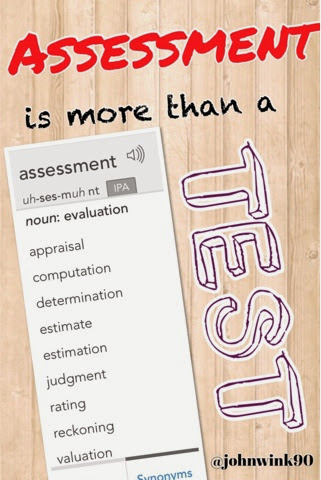
But here's the deal. Assessment is not testing.  Assessment is determining if learning is actually taking place.  In fact, assessment is a vital component on excellent instruction, and without assessment, you're not delivering instruction.  You're disseminating information and opportunities to learn. 

So here are 5 ways to assess without testing.

  1. Listening - If you listen to kids, and they can't talk about their learning or content, they aren't learning the content.  
  2. Observation - Watching kids interact with content tells you what misconceptions they have with content. 
  3. Conversation - A conversation with a kid about his understanding of the content will tell you so much more than any test ever could. 
  4. Portfolio - Collecting samples of authentic student work over time gives teachers the full picture of a child's learning from initial instruction to the end of the unit. 
  5. Anecdotal records are similar to observations, but they are more detailed as the teacher can make record of all the informal learning a child has demonstrated over time. It also shows patterns of incorrect learning


Here are some bonus ideas from my PLN. I posed the following question, "How do you assess without testing or grading?"  I really enjoyed their perspectives, and hope you do as well.


Drop a comment.  How do you assess without giving a test?


Monday, July 14, 2014

7 Secrets of Excellent Deskside Manner

Being in the hospital with my daughter for the last 3 days following her accident taught me one thing.

#Bedside_Manner_Matters

With all of the nurses, doctors, social workers, therapists and other medical experts coming in and out of the hospital room, my confidence in their abilities was greatly affected simply by how they treated my daughter, my wife, me, and other people in the room. The more empathic they were, the more I trusted in their ability and advice.  The more indifferent they were, the less faith I had in their prognosis and their prescription. 

How good is your bedside manner with your patients (i.e. students and their parents)?  No, you're not a doctor, but you do diagnose, prescribe and advise students and their parents.  You use your expertise to inform on the progress of student learning. Your ability to communicate that information, AKA your Deskside Manner, matters. 

So How Good is your Deskside Manner?

Do you give it the attention it deserves?  Here are 7 secrets to consider before you make your decision. 

1. Do you make your guests feel comfortable or uncomfortable when you enter the room?

2. Do you greet people with a smile and positive tone in your voice or a pensive posture?

3. Do you speak with a confident or condescending tone?

4. Do you communicate progress using parent friendly terms or educational jargon?

5. Do you cut people off when they're talking or asking questions, or do you allow them to finish their sentence before speaking?

6. Do you validate people when they ask stupid questions or do you make them feel stupid for not asking a valid question? (BTW, there are no stupid questions.)

7. When the patient is stressed or anxious, do you calm their fears or amp their attitude?

The bottom line is this. How you treat people matters. People will pay attention to your intellect after you validate theirs. 


Friday, June 20, 2014

From Engagement to Empowerment

Bill Ferriter wrote this bit about student empowerment versus student engagement (Check out his blog). The crux of his post centered on the fact that if we want to empower students in their learning, we have to construct content in such a way that challenges students to take ownership. He went on to say that engagement is good, but the problem is that students can't be empowered to learn content that is owned by the teacher. They can only be engaged in the content.

So how does this apply to principals and teachers? 


Well, the first thing that principals need to understand is that engaging their followers is not the ultimate goal but the first step.   Leaders guide followers in committing to a mission that clearly defines why they're all there.  I mean if you can't engage followers in directing their moral compass, there's no way you're ever going to empower them to realize their true purpose. Engagement is about connecting people to what must be accomplished and that's an important first step to empowering followers. 

Engagement also requires promotion. 

Here are a few questions to see if you are engaging your staff.

  • Are you promoting the things that your school is trying to do for all kids?  
  • Are you creating a sense of excitement about the future of your school?
  • Are you celebrating the behaviors that are helping your school move forward?
  • Are you showing evidence that what you are doing is working?

When you are doing these types of things as a leader, people are interested in becoming engaged because they are attracted to what you are trying to create. Everyone wants to be a part of an organization that is focused on making progress because deep down inside everyone wants to be a part of an improvement movement. 

From engagement to empowerment. 

Once people are engaged, they are primed to be empowered. Empowerment is hard for leaders because it requires leaders to give up control. As people become actively involved, they naturally need the opportunity to take actions and make them their own.  Control must be shared with those that get it and more importantly want it, so they can help engage and then empower others who are impacted. If people are not given control of how to improve the school, you can't say they are empowered. To move from engagement to empowerment, the leader needs to focus on these questions. 


  • Are people asking for permission to do things differently than you described?
  • Are people not changing and adapting to the needs of kids because they feel like they're not allowed to?
  • Do people feel like they need to do their work in the same way as everyone on their team?

If you answered yes to any if these questions, your staff is not quite ready to be called empowered. 


The Essence of Empowerment is Control

Who's in control in an empowered culture?  It is pretty difficult to be empowered when you feel like you have no authority to select the path of your own personal progress. Empowering leaders facilitate shared control in an environment where risk-taking is rich and responsibility is shared.  In an empowered culture, people don't need permission because they have a purpose.  Once leaders realize that they must replace their chore of constant control with inspirational motivation, idealized influence, and intellectual stimulation, they will begin to move their organization from engagement to empowerment. 

Tuesday, May 6, 2014

7 Steps to Conquer Twitterphobia

I get so tickled when I'm talking to someone who says, "I don't get Twitter."  They complain about the hashtag (for old folks, the pound sign) or why there has to be an @ symbol just to talk to someone. Their pontification of pensiveness is quite amusing.

After listening to them lament over their Twitter-phobia, I ask them one simple question.  "Do you use Facebook?"  Their answer is typically, "Well, yes", followed by, "but you don't understand.  I don't get all that # stuff."

So I'm tired of listening to all the excuses.  I want to tell all of you Twitter-phobes that there are 4 reasons you should be using Twitter. 

1. 140 characters is Facebook minimized
Think about it. No one reads your Facebook posts when you have more than 140 characters anyway, and let's face it. You don't read peoples' lengthy posts on Facebook either. Anything that you can post of FB can be tweeted on Twitter. 

2. Hashtags Connect
The great thing about Twitter is that you don't have to know everybody or be everybody's friend. The # connects people around topics of interest.  For example, #satchat (Definitely click here!!!) is one of the most popular chats on Twitter for educators. On Saturday mornings, you can find 100's if not 1000's of educators conversing in this forum about really interesting topics in education. 

3. Friends are overrated
Let's face it. When you are reading Facebook there are lots of people you tune out.  After they've said the same thing over and over for the last few weeks about politics, their family, or their personal problems, you really don't pay attention to anything they say.

Twitter is pretty transparent, and it's not that personal, which is a good thing if you're trying to learn from others. I have developed some pretty awesome contacts over my four years on Twitter, and that is because of the transparency and openness that you find by connecting with other educators who you would otherwise never meet. I don't know any of them personally, but I find my closest tweeps to be extremely powerful influences on my work. Friends influence you, but strangers stretch you. 

4. You're wanted on Twitter
There are lots of people out there that want to help people new to Twitter. Chats like #NT2T (New Teachers to Twitter) created by Joe Mazza (Click Here) and Twitter leaders such as Jerry Blumengarten (Click Here) are extremely powerful resources to all tweeps, especially those that are new to Twitter. 

Following bloggers such as Bill Ferriter, Dean Shareski, Eric Sheninger, and David Culberhouse keep me up-to-date with the latest things happening, and their cutting edge thoughts influence my life as a leader. 

Are you willing to try something for me?


I'd like for you to try these 7 steps to see if Twitter is for you.  If you still have Twitter- phobia after these 7 steps, I'll give you a complete refund. (That's a joke...)

Step 1
Set up an account. It's not that difficult. In fact, here is a quick video to help you get started. 


Step 2
Find some people to follow like the people that I just mentioned. Don't worry. They won't bite. 

Step 3
Look at the people that they follow.  Check out their bio and the tweets that they put out.  If they appeal to you, follow them. If not, don't. 

Step 4
Spend some time reading and analyzing how people tweet and use the # to communicate. 


Step 5
Find a regularly scheduled chat and participate in it either by tweeting or by just watching the hashtag. It can be a little overwhelming and intimidating, but watching how the conversation works will give you a good understanding of what Twitter is all about. See Jerry Blumengarten's Twitter Chat Schedule Page


Step 6
Find some of your friends that use Twitter, and talk to them about how they use it to learn. 


Step 7
Remember that everyone was new to Twitter at some point in their life. They were intimidated. They were nervous about sending out tweets, but they got over it, and you can too.

Conquer your Fear

Technology can be a challenge, but the more you use it, the more confident you will be with it. Twitter has changed my life as an educator. It has stretched me in ways that traditional PD never could. I have learned things that I would never have learned in any district that I worked in. I was once scared of Twitter, but after taking a chance and jumping in, I realized that there was nothing to fear but fear itself.   I hope you'll give it a go and conquer the senseless fear of Twitter.


Sunday, March 2, 2014

6 Symptoms of a Contagious Classroom

The flu season never seems to end. The stomach bug comes through and wipes the classroom out like a tidal wave. It seems like sometimes the classroom is nothing but a contagious pool of germs. As soon as one student comes back from being sick, two more go home with the same symptoms.

Got hand sanitizer?

Here's my question for you today. Is your classroom a place that is infesting with contagious germs for learning?   In other words, do students walk in the door and instantly catch the bug that you're infected with?  Does your passion for learning motivate the apathy out of kids?  

Here are 6 Symptoms of a Contagious Classroom. 

Intrigues high achievers

Nurtures struggling learners

Fascinates average abilities

Empowers all learners to own the content

Connects learners to one another

Transforms acquisition of information into passion for learning. 

So are your Kids Infected???

If your instruction has these 6 components, chances are that the kids are infected with inspiration. If you have a contagious classroom, apathy is absent. Interest is invigorated, and learning is growing by leaps and bounds.  Finally, are you a contagious teacher?  If so, you don't have a job.  You have an awesome affliction. 

This week, catch the bug and infect your students with it.


Tuesday, February 11, 2014

The Work Ratio

Converting curriculum into instruction takes a lot of work. Designing learning from introduction to mastery can be a challenge, and the more diverse learners you have, the more diverse instruction is required. In every classroom a teacher plans for instruction, and we call that teacher work.  Students receive the information and respond to the instruction, student work. Some classrooms have instruction that makes a tremendous impact on students; therefore, the amount of student work is higher than the amount of teacher work. Conversely, in other classes, teachers are working much harder than the students and therefore, the instruction has minimal impact on students. In other words, instruction is negligible.

Why is that?

If you think about the very best teacher you ever had, you can quickly say that the teacher got the very best out of you. His or her effect on you was tremendous. The other thing that made this teacher tremendous may have been her ability to make learning meaningful by designing work that mattered to you. To sum it up, the student work was much greater than the teacher work. 

In a weak classroom, the amount of work on the teacher is always much greater than the amount of work on the student. No matter how hard the teacher teaches, or how much he tries to improve the effectiveness of his work, little will change as long as he ignores the work that students are expected to do. 

In all classrooms the key to learning is engagement. How we engage students in the the work of learning is critical. The focus on learning requires teachers to put the emphasis on increasing student work to a point that it exceeds the amount of teacher work.  To make student work transfer into learning, there exists five conditions that can negatively affect or positively impact the the student to teacher work ratio.

Relational Rituals 
When students enter the classroom, do they know how to interact with the classroom without the teacher's direction?  Do students feel like they are a welcomed member of the classroom?  Do they feel like the classroom procedures are designed specifically to make them more successful in learning?  
If we want students to be successful in the learning process, they have to know that the procedures of the classroom are designed to make them more successful in learning, not to make them more compliant to the teacher's rules.

Accountability
Is the accountability for student learning  and behavior completely driven by the teacher?
Do students know the areas that they are weak in and areas that they are strong in, or is that completely determined by the teacher?

In a classroom that has a strong effect on students, accountability is shared by the student and by the teacher.  The more that students take personal ownership of their proficiencies and learning, the more they will take purposeful steps to own the work that will improve their learning. 

Time Optimization
Is time monitored closely by the teacher?
Do students have idle time when they complete tasks or assignments?
Are there periods of time where students daydream or get off task during instructional activities. 

Time management is completely dependent on the teacher's ability to perceive which tasks are optimizing time and which tasks are wasting time.   Wasted time will always cause the instructional impact to decrease substantially; therefore, teacher will increase because student work decreases. 

Individualization
Is the instruction delivered in such a way that students can learn at their own pace and in their own unique modality? 
Are students forced to learn mostly in the same manner, pace and modality?

When the instruction is predominantly in the whole group mode, the student will never exceed the teacher in the work ratio. When the class has to learn content in the same format at the same speed and in the same way, there is no way that students can work harder than the teacher. That is because the teacher has to control the time each activity takes, the speed all students must learn and the method that students are required to learn. Students need individual time to apply their learning in ways that work best for the learner not the teacher. 

Ownership
This question is pretty simple. Who owns the learning, the student or the teacher?  If the student learning has to move at the same rate as the teacher's instruction, the ownership cannot possibly belong to the student. At the same time if the instruction is not designed in a way to put the student in the driver's seat of how they acquire the learning, there is no way the student can own the learning. Ownership can only occur when the student is able to take the instruction that is provided and be given the opportunity to make meaning in their own unique way. Being able to create useful products and purposeful projects are surefire ways that students can fully possess their learning. 

So what's the Student to Teacher Work Ratio in your Class?

Are you working harder than the kids?  Are you taking more ownership of the learning than the kids are?  Are relationships weakening because the work is mundane to the kids?  Are kids in a position to conform their learning style to your teaching style?  If any of these questions identify with you, it may be time to reexamine the strategies that you are employing.  It may be time to find new ways not to get more work out of the kids but to get more meaningful work out of them. 

Friday, February 7, 2014

5 Challenges from Kindergarteners to all Educators

I did walk-throughs in my kindergarten classrooms last month. All I can say is wow!!! Kids are capable of so much, if we remove the barriers of our own biases. Today's post is in honor of my kindergarten teachers and their awesome students. The strengths that they pull out of kids are a testimony of what every educator must do for all kids.

As I reflect on my own experience, I sometimes stopped student potential simply because of my own biases of what I thought students were capable of.  We all do that from time to time.  We allow our own experiences and failures from teaching kids to limit our expectations for all students.  So here is a little challenge for all of us when we begin to doubt what all students can do.  The kindergartners at our school are doing amazing things, and that is because of the limitless expectations of our teachers.

If kindergartners can...


Write nonstop for 25 minutes using their sight words and letter sound knowledge, then all students have the potential and stamina to concentrate as they create meaningful examples of their learning. 

Present their writing to the class, then any student can stand in front of an audience and share their knowledge and their learning with others. 

Receive constructive feedback from their peers about their writing, then any student can be confident displaying their work for other students to critique. 

Read their writing to their peers, all students can be expected to read and write at high levels every day in every class. 

Help one another make their writing better, then all students can collaborate on their work in an effort to make it better and to learn from one another. 

You can virtually teach everything a kid needs in kindergarten. Sure, content will get more complex over the years, but the idea is this. Kindergartners come with little educational experience. Aside from PK (which does an amazing job preparing kids for Kindergarten), we assume they can do very little. The sad thing is that we believe this mess. Kindergartners come to school with tons of knowledge and absorb everything we throw at them. All kids in grades PK-12 are the same. They come with immense potential, and our job is simple:  create a motivational environment full of wonder and amazement so that kids will demand of themselves to not only meet but exceed their potential. We must challenge and applaud kids when they take risks, share their failures and celebrate their successes with their peers.  We must constantly promote a thirst for new knowledge, and we must model being passionate about learning and life. After all, passion is what kindergartners have when they start school. Our job is to make sure they never lose that passion throughout not only their education but their life. 

#EasyToSayHardToDo

Sunday, January 5, 2014

Finding a Socket for Every Plug

My daughter just made the drill team, and I am extremely excited. It was such a proud moment to watch her overcome obstacles to accomplish this goal.   The most impressive part of her accomplishment was her grit and determination. She was obsessive in her tireless pursuit. She practiced every day, and she attended every possible practice to get better at the art of dance. 

Needless to say, I'm very proud of her!


What made the difference?  Sure, she has two parents that support her. We give her encouragement and advice in times of difficulty. We teach her the importance of never giving up. But we're not the only ones.  Her teachers and her friends play a huge part in building her confidence and self-esteem. They give her lots of feedback that helped her every day inch closer to achieving her goal. 


In short, she is lucky because she is plugged in.  Think about it.  An appliance is no good if you can't plug it into an electrical socket. Take a coffee pot for example.  Mine simply won't work unless it is plugged in.  Even worse, it has a short plug, so I have no choice but to place it very close to an outlet to plug it in. That is if I want some coffee. I can demand and plead for it to make my coffee, but if it isn't plugged in, the pot just simply won't do a thing. 

Kids are much the same. Every one of them has a plug, but they won't work until they are plugged into a socket. You can beg, plead, entice or threaten, but kids only work when their plug is in the socket. 

Some kids, like my coffee pot, have a very short cord; therefore, they have to be very close to a socket. In other words, we really have to dig into their mind to truly understand who they are, what their interests are, so we can build a relationship that will help them move closer to a socket. This takes a lot of time, trust and patience, but it is the only way to get kids interested in plugging in. 


How do we plug in kids?

Unlike the coffee pot, I can't plug kids in. That is their choice. When they are intrigued, inspired, and motivated, they will make a conscientious effort to plug themselves in. Kids must see that engaging in learning is worthwhile and ultimately beneficial to their lives. That can't happen without an enthusiastic educator who loves what they do and gauges their own success by how many kids they can connect to learning. 

Plugging kids in to the socket can be challenging, but the last thing I'll share is this. Educators shouldn't focus on plugging kids in to the educator's socket of choice. They must be committed to creating the conditions for kids to seek out their own unique socket and plugging themselves into their new-found passion, deepening their knowledge about it, and finally redefining their life in a way that they never imagined. 

A coffee pot can be as pricey or as plain as possible; however, they're worthless without power. Kids can be affluent or poor, but without plugging in to their passion, they won't accomplish much. The difference is me and you and whether or not we believe in our purpose of inspiring all kids to plug themselves into their future. 

Thursday, December 12, 2013

Teaching Kids the Highest Leverage Skill

In our standards-based education system, we are engaged in a never-ending effort to teach every high leverage skill. We focus on skills that are so critical that they are foundational for learning standards far into the future.  If you have ever worked with a student that had gaps in his learning, you can instantly tell where his gaps lie. You can quickly identify the skills that he is missing. Some students close gaps quicker than others and some never do. Why is that?  

It is because few kids possess the highest leverage skill. 

Some people feel that reading comprehension, fluency or numeracy are the highest leverage skills, and they are from an academic perspective.  But without the mindset for learning, these skills struggle to grow. 

So what is the highest leverage skill?

Some people look beyond academics and feel that self-confidence is the highest leverage skill. With it, you can do anything. Without it, growth is minimal. Kids, that make the biggest gains, do so because they have been hard-wired to believe in themselves.  This positive image of one's own abilities generates strength and the desire to take risks. Like it or not, self confidence is not the highest leverage skill. 

Some believe persistence is an invaluable skill. To learn difficult concepts, kids must have resolve. They must keep going when they hit the brick wall. Persistence is what turns practice into progress, but I'm sorry to say that while persistence is valuable, it is not the highest leverage skill. 

Enough Already, What is the Highest Leverage Skill?

Hope.  Eric Jensen sited hope as the difference between students of poverty making it or not. Hope is the eternal belief that life will get better. No matter the obstacle, circumstance or barrier, hope of a brighter future is the only thing between a student's reality and his potential.  In short, self-confidence and persistence can't exist unless there's hope. 

How do we teach hope to our kids?

Educators must transform the role of content-instiller into that of hope-builder. We possess massive potential to turn hopelessness into a viable vision. We build hope in students by doing the following things:

1. Help students create their own meaningful pathway to a better life. 
2.  Set challenging but realistic goals to measure progress along the way. 
3.  Guide students to find short-term wins. 
4.  Facilitate student thinking and problem solving through setbacks and losses. 
5.  Teach kids a never-give-up mentality. 

How do educators become hope builders?

1.  Stop thinking about teaching content and start teaching kids.  Content will come once we focus on teaching kids. 
2.  Connect with kids on a human level. Relationships are the pathway to learning. 
3.  Model hope by expressing personal beliefs in students to everyone we encounter. 
4. Never give up. Never give up. Never give up. 

Hope is the antibiotic to fear and uncertainty. It is the GPS used to navigate the winding road of success. Hope overcomes obstacles and dissipates doubt. Finally, it is accompanied by faith, joy and love. 

Got hope?


Saturday, April 20, 2013

Angry Bird Learning

Angry Birds was an instant hit when it came out on the app store several years ago. The addictive seduction of the game was based on trying to get three stars at each level. I could get through a level with one star, but that wasn't good enough for me. I had to get the most points and the most stars before I would allow myself to move to the next level. Experimenting with the trajectory of my shot as well as where to place the birds to destroy the pigs' lair fed my addiction.

So why can't learning be that way?
The traditional way of learning motivates students to strive to solve easy problems and avoid difficult ones to get the most points. Knowing that mindset was the challenge for most students, we decided to flip this paradigm on its head. Our teacher teams in mathematics created three levels of difficulty for each math concept that all students needed to master:  1-Star, 2-Star, 3-Star. 

1 Star Problems

Level 1 challenges students to master the skill in its most basic form.  The good thing about having level 1 problems is that it helps teachers drive intervention.  If students fail to understand the basic concept in its simplest form, teachers know that remediation begins at the basic level of understanding. 

2 Star Problems 

Once students master level one problems, they move on to 2-Star Problems. These problems challenge students to master the skill in problem-solving situations that are limited to one or two steps. The idea behind 2-Star is that students apply their basic knowledge with more challenging problems.  If students master 2-Star problems for that skill, the student earns a blue star where they write their name and the skill on the star. The star is then posted on the wall in the grade level hall for all students and staff to see. Again, the great thing about 2-star problems is that teachers can focus their interventions on guiding students to understand how to apply their knowledge of the skill in basic problem-solving situations. 

But two stars isn't good enough for our students.   They are hungry for 3 star problems. 


3 Star Problems

Once students master 2-Star problems, they now solve the most difficult problems at level 3. 3-Star problems involve the highest level of rigor, and exceed the complexity that students will see on state standardized test (STAAR). Now, most students groan when they see challenging problems, but this is where the Angry Birds philosophy transforms students into learners. Because the students are motivated to do their personal best on one particular skill and they want their name posted in the hall, they do not see challenging problems as an obstacle but an opportunity they tackle with their mental dexterity. To be honest, it's pretty amazing to watch the students jump up and down with excitement when they have mastered the third level. Moaning is transformed into motivation. 

Angry Bird Learning 

The beauty of the Angry Birds philosophy is that it is not a massive change in the task, but a massive change in the mindset. By converting the problem into the prize, students are hungry and eager to demonstrate their learning quickly, so they can have their name on a star posted in the hall.  Excitement about learning gets harder as the year goes on, but if you build new and different extrinsic motivators into your learning, intrinsic motivation will follow. This spring, tie your learning to the philosophy of one of the best selling games of all time, and then watch the students get fired up to master skills and become intrinsically motivated to excel at learning.