Showing posts with label Assessment. Show all posts

Friday, November 28, 2014

The Best Assessments Motivate All Students

In meaningful collaboration, there are always discussions surrounding the topic of how we know if kids are learning, and how we help them move forward.   Every teacher always wonders what the best ways are to assess student mastery of content, but here's the question. Do we consider assessments from the student's perspective or the teacher's perspective?  A great resource to solve this dilemma is Dylan Wiliam's "Embedded Formative Assessment".  In addition to his work, there is tons of research that says this.


The Best Assessments Motivate Students


  1. Accuracy requires the task that we give kids to be tied directly to the learning standard that we expect all kids to master.
  2. Descriptive feedback is more or less how educators provide specific information to help students know exactly what they need to do next in their learning.
  3. Student involvement means that students own the process.  If students are not involved in the learning process, then how can we expect them to be an active participant in closing their own gaps.

What does All of This Mean?

As we work with kids, the question circling through our minds shouldn't always be how do we know if kids are learning.  It should involve this kind of internal reflection.

  • What is the learning target that we want all students to master?
  • What is the best task that will meet these 2 criteria:
    • Peak student involvement and interest in the learning standard,
    • Aligned to the learning standard with depth and complexity
  • What types of feedback will we need to give students that will:
    • Scaffold learning for students
    • Be tied directly to the standard.
  • How will we: 
    • Determine when students master the skill,
    • Report mastery in a meaningful way that will help students move forward.
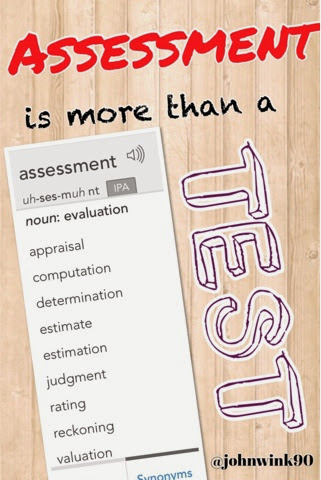
Assessment has such a bad perception because so many people think that it means test.  Assessment has Latin roots, and its original definition means "to sit beside".  My hope is that when we assess learning, we remember that our chief job is not to give a test or quiz but to give meaningful tasks that will allow students to connect with our content in powerful ways.  After all, that is the ultimate goal of learning, to connect kids with 'their' learning.  The best assessments don't make learning the goal.  They make learning the reality.

For more ideas about assessment, check out my post, 5 Ways to Assess without Giving a Test.

Friday, July 25, 2014

5 Ways to Assess Learning without Giving a Test

I ran into a little push-back about assessment.  The chief complaint was that increasing the number of assessments requires teachers to give up more instructional time to test kids.  I couldn't agree more with. We don't need more tests. We need more instruction. 

But here's the deal. Assessment is not testing.  Assessment is determining if learning is actually taking place.  In fact, assessment is a vital component on excellent instruction, and without assessment, you're not delivering instruction.  You're disseminating information and opportunities to learn. 

So here are 5 ways to assess without testing.

  1. Listening - If you listen to kids, and they can't talk about their learning or content, they aren't learning the content.  
  2. Observation - Watching kids interact with content tells you what misconceptions they have with content. 
  3. Conversation - A conversation with a kid about his understanding of the content will tell you so much more than any test ever could. 
  4. Portfolio - Collecting samples of authentic student work over time gives teachers the full picture of a child's learning from initial instruction to the end of the unit. 
  5. Anecdotal records are similar to observations, but they are more detailed as the teacher can make record of all the informal learning a child has demonstrated over time. It also shows patterns of incorrect learning


Here are some bonus ideas from my PLN. I posed the following question, "How do you assess without testing or grading?"  I really enjoyed their perspectives, and hope you do as well.


Drop a comment.  How do you assess without giving a test?